
State-Driven Attribution: Beyond the Last-Click Fallacy in AI-Powered SaaS
Last-click is a lie. Discover why the only way to measure AI-driven growth is through state-based attribution in a unified behavioral graph.
The Attribution Crisis
Every growth marketer lives with a uncomfortable truth: our attribution models are mostly guesswork.
In the linear era, we used "last-click" or "first-click" because that’s all our spreadsheets could handle. We attributed a $10k expansion deal to the last email the user clicked, ignoring the 40 feature interactions, 3 support threads, and 2 AI-generated re-engagement nudges that actually built the conviction to upgrade.
In the AI era, where interventions are autonomous and hyper-personalized, linear attribution doesn't just fail—it misleads.
You cannot measure a non-linear journey with a linear ruler.
The Problem with Time-Based Attribution
Time-based models assume that the proximity of an event to a conversion determines its influence. But in complex SaaS, influence is decoupled from time.
A user might read a deep-dive technical blog post on Day 3 that fundamentally changes their mental model of your product. They don't convert then. They convert on Day 12 after a simple "forgot your password" flow. Traditional models give 100% credit to the password reset.
This leads to "Vanity Optimization": we spend more on the tactics that appear at the end of the funnel, while starving the high-leverage "State Shifters" that actually move the needle.
Enter State-Driven Attribution
State-Driven Attribution moves the focus from time to topology. Instead of asking "When did they click?", we ask "What state transition did this action cause?"
In SynapseFlowAI, every user exists as a node in a Visual Synapse Graph. Their "state" is a composite of their behavioral history, product depth, and intent signals.
- 1The Starting State: User is "Exploring API Docs" with an intent score of 45.
- 2The Intervention: An AI agent triggers a contextual RAG-powered email explaining a complex integration.
- 3The Target State: User successfully connects their first production database. Intent score jumps to 85.
The intervention is credited with the Delta of Intent it created, regardless of when the final conversion happens. This is the only way to accurately measure the ROI of AI workflows.
The Three Pillars of State Attribution
To implement state-driven attribution, you need three architectural components:
1. Unified Behavioral Graph You cannot attribute state changes if your data is siloed. You need a Data Orchestration Hub that unifies Stripe, PostHog, and custom webhooks into a single source of truth.
2. Probabilistic Influence Modeling Not every action is a 100% cause. State attribution uses Markov chains and probabilistic models to determine the "Weight of Influence" each node in the journey holds. If 80% of users who convert passed through "Node X," then Node X is your primary growth lever.
3. Real-Time Feedback Loops Attribution shouldn't be a post-mortem. It should be a live signal. When the Real-Time Execution Engine identifies a high-influence path, it should automatically route more users into that state.
Moving Beyond the Dashboard
The end of the "Dashboard Era" means the end of passive reporting. Revenue & ROI Analytics should tell you more than just "how much we made." They should tell you "what shifted the state."
When you understand state transitions, you stop guessing and start orchestrating. You stop optimizing for clicks and start optimizing for conviction.
The future of growth is not about the last click. It’s about the next state.
Ready to boost your trial conversion?
Join our waitlist and be among the first to experience Synapse Flow AI.
Join our DiscordMore from the blog
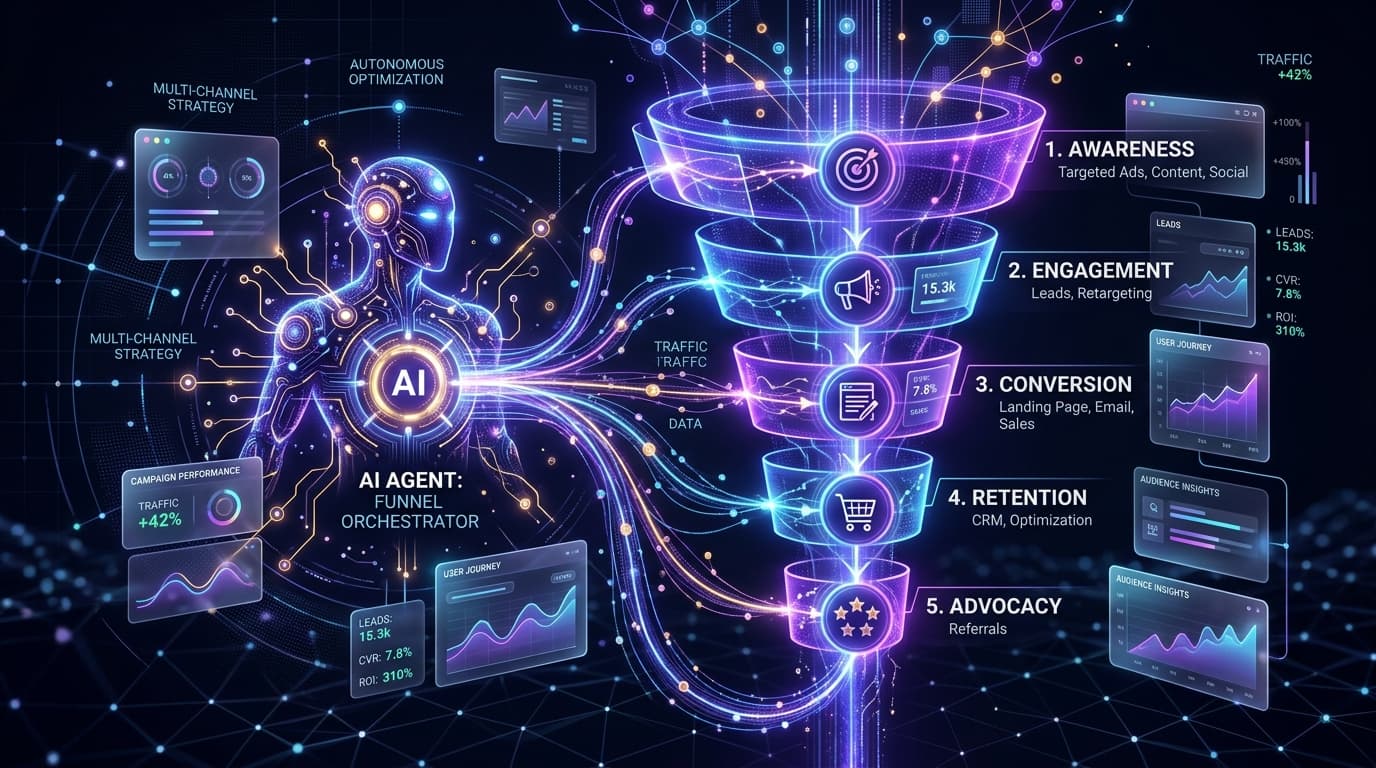
Orchestrating Activation with Autonomous AI Agents
Discover how autonomous AI agents replace rigid marketing flows by continuously experimenting to find the fastest path to your user's trial activation.

Streaming Infrastructure for PLG Conversion Engines
Learn why real-time streaming architectures are essential for triggering sub-second interventions and maximizing trial conversions in B2B SaaS platforms.

Bridging the AI Sales Intent Chasm in B2B SaaS
Bridge the gap between product usage signals and sales outreach by orchestrating AI-driven contextual handoffs that convert free trials to enterprise.