
The Multi-Agent Revolution: When One AI Is Not Enough
Single LLMs create content; multi-agent systems run growth. Learn how coordinated agents enable autonomous SaaS execution at scale.
One Brain Is a Bottleneck
In the early days of "AI-powered" SaaS tools, the promise was simple: replace a human task with a language model. Write an email? GPT does it. Summarize a support ticket? Done. Qualify a lead? Sure.
But there's a ceiling to what a single AI model can do inside a complex system. Ask one LLM to simultaneously monitor real-time product telemetry, reason about churn risk, generate hyper-personalized outreach, manage API rate limits, and orchestrate a multi-step sales handoff—and you get something that looks smart but performs like a committee with no agenda.
A single LLM is a genius working alone in a room. A multi-agent system is a coordinated team, each member an expert in their domain.
What Is a Multi-Agent System?
A multi-agent system is an architecture where multiple AI agents—each with its own specialized role, memory context, tool access, and decision scope—collaborate to accomplish goals that no single agent could handle reliably alone.
Think of it as organizational design, applied to AI:
- The Orchestrator Agent receives high-level objectives and decomposes them into subtasks.
- The Sensing Agent monitors real-time event streams and updates the shared state graph.
- The Reasoning Agent evaluates user context and selects the optimal intervention strategy.
- The Content Agent generates personalized, channel-appropriate communications.
- The Compliance Agent reviews every outbound action against regulatory and brand guardrails before execution.
- The Learning Agent instruments outcomes and updates the system's decision model.
Each agent is narrow, fast, and expert. The system as a whole is broad, adaptive, and intelligent.
Why Single-Model Architectures Fail at Scale
Single-model architectures collapse under three specific pressures:
1. Context Window Exhaustion
A single LLM has a finite context window. In a real-time growth orchestration scenario, the relevant context for a single user decision can include: 14 days of behavioral history, 3 active support threads, billing status, competitive intent signals, CRM notes from 2 SDR calls, and the output of the last 6 AI-generated messages sent to that account.
Fitting all of that into a single prompt—while also executing the reasoning and generation—is not just inefficient. It is architecturally broken. Critical context gets truncated. Decisions degrade.
In a multi-agent architecture, the Sensing Agent maintains a compressed, purpose-built state snapshot. The Content Agent receives only what it needs to generate the next message. No agent is asked to do everything.
2. Specialization vs. Generalization
A general-purpose LLM is optimized to be good at everything and great at nothing. A growth orchestration system doesn't need generality—it needs extreme competence in a handful of specific domains.
The agent responsible for churn detection should be fine-tuned on the behavioral signatures of at-risk users in your specific product category. The agent responsible for compliance review should be trained on your approved claims registry and applicable regulatory frameworks. Asking one model to do both—simultaneously—is how you get emails that are both legally risky and strategically wrong.
3. Parallelism and Latency
Sequential single-model processing creates unacceptable latency in real-time orchestration. If a high-intent signal fires—say, a trial user just invited their VP of Engineering and connected their production database—the window for an optimal intervention is measured in seconds, not minutes.
A multi-agent architecture runs in parallel: the Sensing Agent detects and classifies the signal, the Reasoning Agent begins evaluating intervention options, and the Compliance Agent pre-validates the likely output—all simultaneously. By the time the decision is finalized, the Content Agent has already pre-generated the message.
The handoff from behavioral signal to personalized outreach drops from minutes to under three seconds.
The Coordination Problem
The hardest part of building a multi-agent system isn't the individual agents. It's the coordination layer.
Without a well-designed orchestration protocol, multi-agent systems suffer from their own failure modes:
- Agent Conflict: Two agents reach contradictory conclusions and the system deadlocks.
- State Drift: Agents operate on different snapshots of the user's state, leading to incoherent actions.
- Runaway Loops: An agent misinterprets the output of another agent and initiates a cascade of incorrect interventions.
This is precisely why the Visual Synapse Graph exists. It is not just a visualization tool. It is the shared memory layer that ensures every agent in the system operates on the same real-time state. When the Sensing Agent updates a user node, every other agent sees that update instantly. There is no state drift. There is no conflict.
The orchestration layer is the nervous system. The agents are the specialized organs. Without one, the other is just biology.
Specialization in Practice: A Real-World Scenario
Let's make this concrete. A trial user at a Series B SaaS company has just entered day 12 of a 14-day trial. Here's what the multi-agent system does in parallel:
- 1
Sensing Agent classifies the user's state: activation score 74%, 2 out of 5 core features adopted, billing page visited twice in 48 hours, team size 8 (6 seats unused).
- 2
Reasoning Agent evaluates the state against the churn risk model: "High conversion probability contingent on team adoption. Primary friction: unused seats suggest the champion hasn't internally socialized the tool yet."
- 3
Content Agent receives the reasoning output and generates two parallel drafts: an in-app nudge for the champion focused on the "invite your team" flow, and a personalized email for the account with a "team adoption checklist" and a direct link to the team management panel.
- 4
Compliance Agent reviews both drafts against the approved claims registry. Flags one sentence in the email that references a discount without explicit approval. Routes for review.
- 5
Escalation Agent simultaneously evaluates whether the account firmographic (Series B, 8-person team, product-market-fit stage) warrants an SDR alert. Determines yes—queues a Slack notification with the full context brief for the Account Executive.
All of this happens in under four seconds. No human was involved in the decision chain. No dashboard needed to be checked. No campaign needed to be manually triggered.
This is not automation. This is orchestration.
The Architecture Shift That Changes Everything
Moving from a single-model architecture to a multi-agent architecture is not a marginal upgrade. It is a categorical shift in what is possible.
- Coverage: You can monitor and respond to every user signal, not just the ones humans thought to build a rule for.
- Precision: Each decision is made by a specialized agent with deep context in its domain, not a general model spreading itself thin.
- Speed: Parallel execution means interventions happen in the window of maximum relevance.
- Resilience: Individual agent failures degrade gracefully. The system doesn't collapse because one component is overwhelmed.
The SaaS companies that will define the next decade are building growth infrastructure that thinks in agents—not in templates, not in drip sequences, and not in dashboards.
You don't win in 2026 by having the best prompts. You win by having the best architecture.
The Synapse Flow Multi-Agent Core
Synapse Flow AI was architected as a multi-agent system from its inception. The AI Cortex Engine is not a single model—it is a coordinated network of specialized agents, each responsible for a specific layer of the growth orchestration stack.
The Encryption Vault ensures that agents operate with the precise data access they need—and nothing more—enforcing the principle of least privilege at the AI layer.
The result is a system that doesn't just automate growth tasks. It reasons about growth strategy, executes with precision, and learns continuously—at a scale and speed that no human team, and no single AI model, could match.
One agent answers a question. Many agents change the outcome.
Ready to boost your trial conversion?
Join our waitlist and be among the first to experience Synapse Flow AI.
Join our DiscordMore from the blog
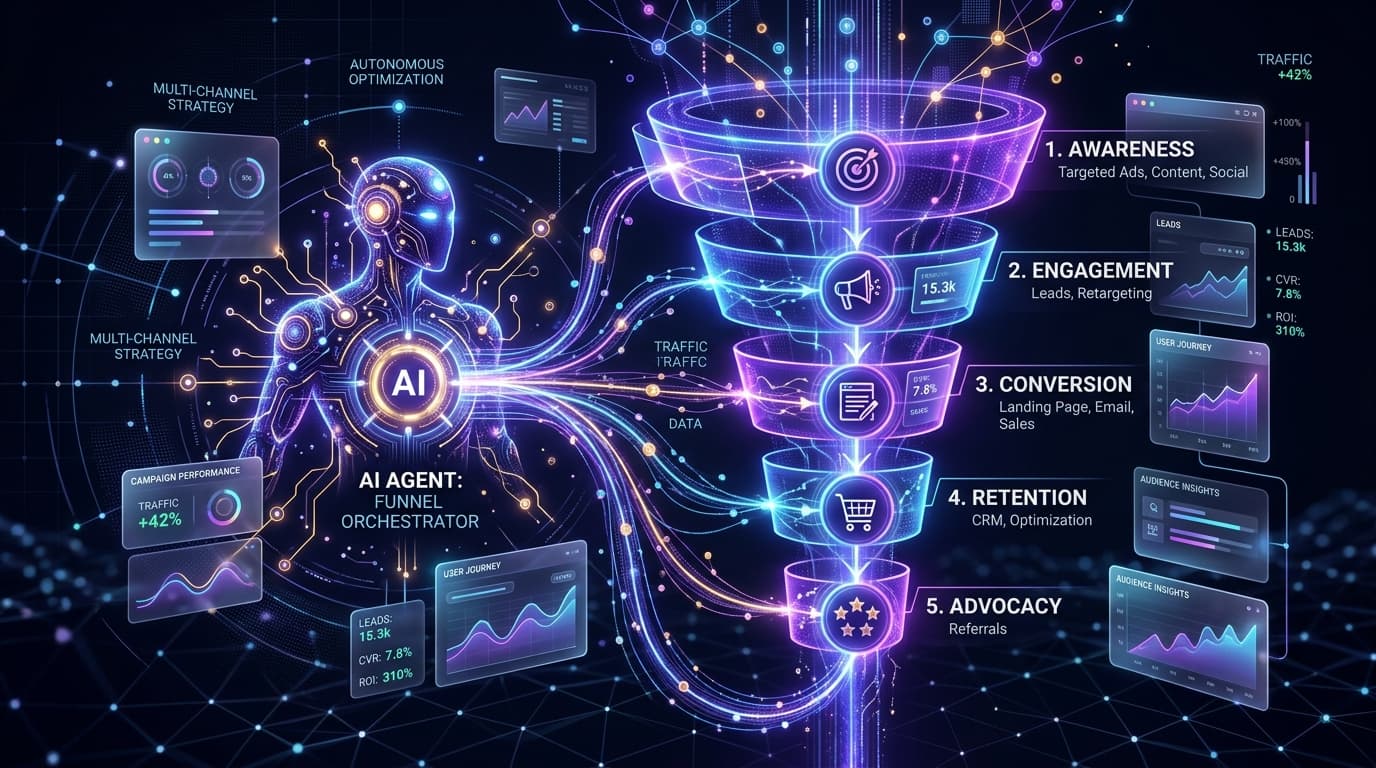
Orchestrating Activation with Autonomous AI Agents
Discover how autonomous AI agents replace rigid marketing flows by continuously experimenting to find the fastest path to your user's trial activation.
Streaming Infrastructure for PLG Conversion Engines
Learn why real-time streaming architectures are essential for triggering sub-second interventions and maximizing trial conversions in B2B SaaS platforms.
Bridging the AI Sales Intent Chasm in B2B SaaS
Bridge the gap between product usage signals and sales outreach by orchestrating AI-driven contextual handoffs that convert free trials to enterprise.